Saturday, July 9, 2016

A Yo-Yo Summer


(Or: There and back again. And there and back again.  And there and back again…)

This summer has been one of those seasons in life when everything seems to happen at once.  They were all good things—wonderful things, in fact—but they did all happen at once, or at least one on the heels of the other.  So for those of my friends who have been wondering why they can never find me these days, this is what I’ve been up to for the past month.


In early June, I had the great privilege of attending the ordination of a dear friend to the priesthood.  The ordination was in New York, so I took a weekend trip from Virginia to celebrate this incredible milestone in my friend’s life.  I don’t have any pictures from this adventure: it seemed the wrong sort of occasion to be snapping photos on my phone!
 
(This is actually the River Avon.)
The week after that, I drove out to South Dakota with my father for a family reunion.  Aside from seeing my grandfather and aunts and uncles for the first time in a decade, I also played my first hole of golf (neither whiffing nor losing the ball—I consider this a success) and took a day trip to the Badlands.
 

If you have never seen the Badlands, you really should go if you have the chance.  You’re driving along a perfectly unremarkable stretch of prairie...
 
 
...(perhaps stopping to feed peanuts to the prairie dogs)...
 
 
...you turn a corner, and suddenly you’re in this sci-fi landscape of bizarre red formations like giant termite mounds. 


It stretches for miles and miles—how the Native Americans and the settlers ever dared to traverse it is beyond my imagination.


And, of course, if you’re in the area, you’re obliged to stop by Wall Drug, the signs for which you’ve been seeing on the highway for at least three hundred miles.


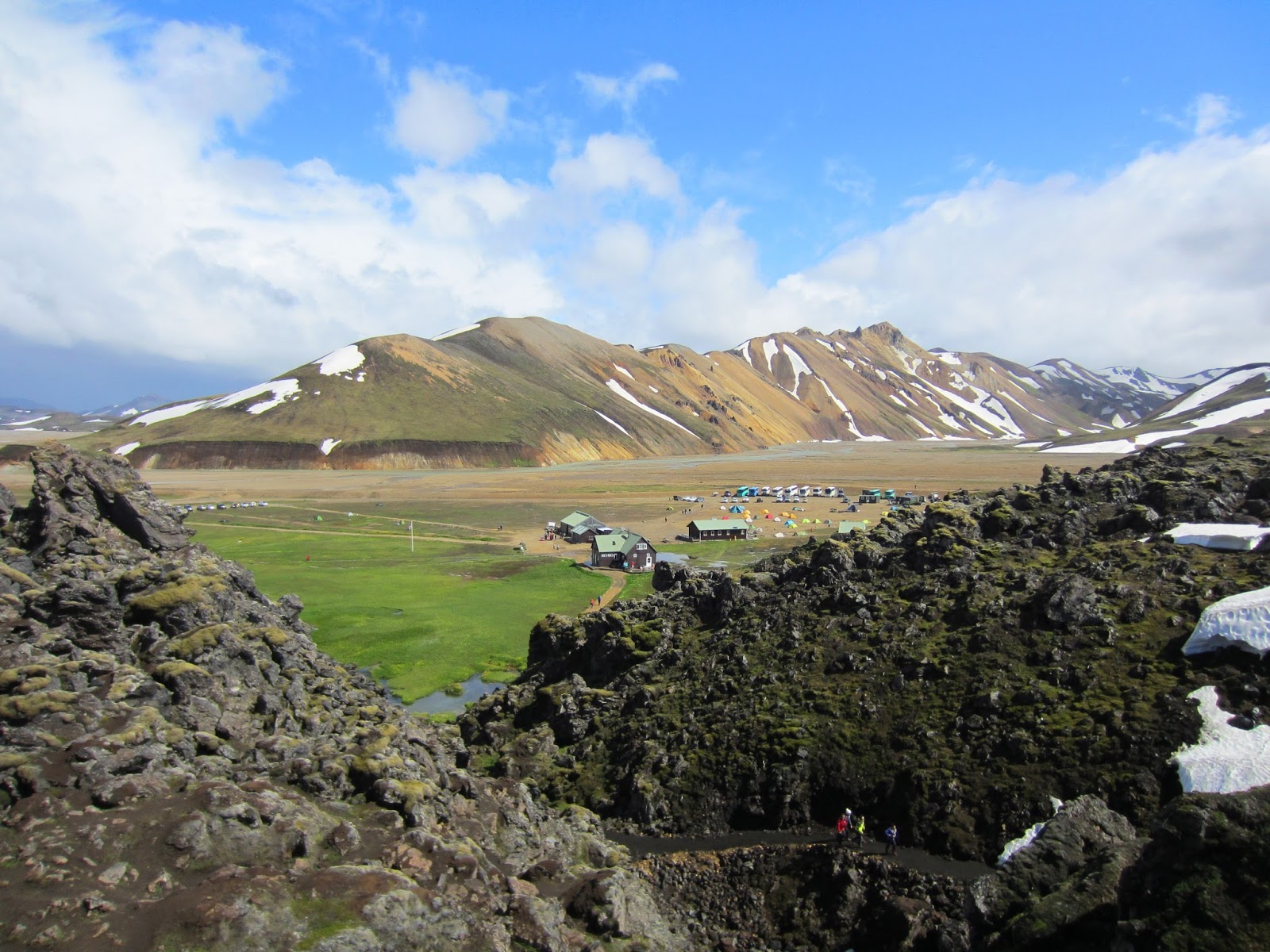
Leaving my dad in South Dakota, I flew back to DC and the very next day flew out to Reykjavik for a week of research.  But what’s a research trip without a day tour?  My friend and I took a break from the books for an excursion to Landmannalaugur, a geothermal area on the edge of Iceland’s vast uninhabited Interior.


This area is just as incredible as the Badlands, and in some ways resembles it.  Only instead of driving through prairie, you’re bouncing crazily on unpaved roads through the lava fields...


...when suddenly you splash through a river and come upon this camp full of tourists in a valley surrounded by mountains.


You get out of the truck, get your bones back in order, and start on a short hike.  In the course of what can’t be much more than a mile, you walk across sheets of snow and ice along the banks of the river…


…passing piles of gleaming obsidian stone…


…you pause for breath of sulphurous air on a steaming Martian hillside…


…you walk through another lava field…


…and you come out, suddenly, onto a plush green meadow filled with buttercups, where all those tourists you saw earlier are bathing in a geothermal spring.


Then, of course, you go make friends with the horses from the local riding tour.


Our tour guide took us the long way back so that we could stop at the foot of Hekla, one of the most violent volcanoes in Iceland.  It used to erupt every ten years—it stopped doing so twenty years ago.  But the lava pack underneath it is still pushing its summit higher and higher every year, so it’s just a matter of time.  The tour guide kept saying that he wished it would erupt, and we all kept thinking, “Not until we get back to Reykjavik, please!”


After my Iceland adventure, my parents met me in Keflavik and we flew together to England for my sister and brother-in-law’s wedding blessing.  Again, I don’t have pictures from this event because it really is my sister’s show and I don’t want to steal her thunder.  I will, however, say that the happy couple were glowing and my parents looked very classy in the clothes they had to borrow for the ceremony because their bags were lost coming from Iceland!  (They caught up with us two days later.)


With my sister and brother-in-law on their way to their overdue honeymoon, my parents and I ventured off to Stratford on Avon, where we saw Shakespeare’s birthplace…


…his wife Anne Hathaway’s cottage…


…and his mother Mary Arden’s farm.  At the farm, we saw a falconry demonstration, which wasn’t actually a falconry demo at all, as the avian star was a barn owl named Millie.  I remember her name because, since it was the end of the day and there were no kids in the audience, the handler picked me to be his “apprentice” and let me hold her on a borrowed glove! 


It was an amazing experience—they really should let more grown-ups try things like this, because we all have hearts for wonder if given half a chance!


The next day it was off to Oxford, where we visited Christ Church and all the terrifically beautiful Oxfordian environs.  (I’ve posted about Oxford before, so I won’t tax my readers a second time.)

 
The gate into Christ Church that tourists AREN'T allowed to use.
The stairway to the Hall (where, as we all know, Professor McGonagall welcomed Harry Potter and the other first years to Hogwarts)
The last full day in England, we went to Croughton, where I was born.  It’s a charming little village with one main street, one pub, and no grocery store. 


This is the house where I first lived:


The best part of visiting Croughton again was seeing my parents reminisce about living there.  It had changed, as all places do, but it was reassuring, in a way, that it hadn’t lost its village-y feel.  I mean, there was a horse pasture half a block from the street where we used to live!


But as wonderful as travel is, all journeys come to an end, and the next day saw us flying home to DC.  Thus ends the yo-yo part of my summer; I hardly count the two-hour trip between DC and Charlottesville, which I have made several times already this summer and will make several times more before I finally head back to South Carolina.


I’m so grateful to have had the opportunity to experience all these wonderful corners of the world, and I hope I’ll have more travels to report on next summer (though perhaps without quite so much yo-yoing?).  After all, sleep when you’re dead, right?

The road goes ever on and on...
 

Thursday, July 30, 2015

Highlands and Dales

Well, never say that I clutter the internet with posts when I’ve got nothing to blog about. It’s been almost a year since my last update, and for those who haven’t forgotten that I’m still alive, here is a fun little tour of the northern half of the United Kingdom for you.

I was lucky enough in July to participate in a conference at the University of Leeds, so I decided to make the most of my plane ticket and visit York, Lincoln, Edinburgh, the Scottish Highlands, and the Isle of Skye while I was in the neighborhood.

The Walter Scott Monument, Edinburgh (with half-assembled
Ferris wheel)
It occurs to me that these areas are some of the most highly touristed places in the United Kingdom, and Google Images will give you better pictures and Wikipedia will tell you way more about the history than I ever could. In fact, during my trip I often found myself thinking of a new word invented by John Koenig: “vemödalen”—the frustration of taking a picture and realizing that thousands of people have already taken the exact same shot. So I’ll post only a few unique-ish ones, leave the history to Wikipedia, and instead share a few thoughts on travel in a foreign country.

Now, having traveled in a fair number of foreign countries, I wasn’t particularly anxious about this trip, about 2/3 of which was done solo.  After all, they speak English in the UK, there are very few terrorists or dangerous animals, and they don’t tend to eat foods that will keep an American up at night with an upset stomach.  And all in all it was a very smooth and pleasant trip.  But you always run into “oddities” when you’re not at home, even when you’re in a place that doesn’t feel at all foreign.  Here are a few of the things that I didn’t expect to be different but were:

1. The sidewalks. The paving stones are never the same size in the UK as they are in America (I’ve noticed this in other countries too), and the curbs are usually much lower than ours. I’ve never seen a grass verge between sidewalk and curb outside of the US.

2. Road markings. I know the English drive on the left, but I encountered a lot of markings I never see at home. Some of them were useful, like the bendy arrows warning drivers that a passing zone is about to become a no-passing zone.  Others were more opaque, like this one that I saw all the time:

I was told it meant “don’t ever stop here,” but I always saw it right before a stoplight. As far as I could tell, it meant “please drive in a zig-zag pattern.”

3. The showers. I could write a whole post just about the variety of showers I’ve encountered.  But just on this trip, I encountered ones that had no visible means to switch from tap to showerhead (there were, however, invisible means), ones that had no shower curtain (most disconcerting in a shared bathroom), ones without hot water (surely a malfunction?), and ones with the towel rack on the far side of the room.  To be fair, I’ve encountered that in American establishments too.  Who designs these things?

4. The toilets. Where I come from, if you don’t have enough water pressure to get the toilet paper down, you hold down the lever down until the paper gets sucked away. In the guesthouses where I stayed, if you did that, the thing wouldn’t flush at all. You have to give the lever one good plunge and then leave it alone. Naturally, I couldn’t figure this out for myself; the hostess had to come upstairs to show me, a grown woman with a graduate degree, how to flush a toilet. She thought I was an idiot but was kind enough not to say so.

5. The beds. This may be unique to guesthouses, but not a blessed one I stayed in had sheets on the bed. I like a nice duvet cover as much as the next person, but not in July!

6. People’s smell. Different soap, different perfumes, different lotion, different deodorant—or no deodorant, which actually isn’t a bad smell if the person showers every day.  In fact, if you stay long enough in a country to buy soap from a local shop, you, too, will start to notice a strange, distinctly not-home smell on your clothes and pillow.

A fried Mars Bar, Scottish specialty (or embarrassment,
depending on whom you ask)
7. The food. This difference isn’t really “unexpected,” and tasting the local cuisine is one of the pleasures of traveling.  But really, the English are remarkable for their ability to come up with different ways of wrapping meat in a pastry crust.

8. The language. We all know that the English say “lift” when we say “elevator,” and that the Scottish say “wee” when we say “little” (I was so happy to hear that they actually still do this, whereas I never once heard a Scotsman say “och”).  But when you have a whole conversation with someone, you confirm the splendid diversity of the English language: cues and nappies and bins and macs for our lines and diapers and trashcans and raincoats. I even saw a sign over a plastic bin that said “Hampers Only.” To me a hamper IS a bin. One of my favorites was something I heard twice, when people trip but catch themselves in time: “Nearly!” they exclaim. And then, at the same time as I was enjoying the British and Scottish flavors of English, I found myself developing a particular pride in my American English; I can’t say I ever used the term “y’all,” despite my current southerly location, but I became acutely aware of how often I drop words of Yiddish origin (oy vey, schlep, finagle), which perhaps aren’t really foreign in England but are generally less a part of everyday parlance.

So perhaps that’s where all travel adventures should end: we deeply appreciate the places we see, the cultures we experience, and the people who welcome us and give us directions and take our pictures without running off with our cameras; but when we come home, we return with a new appreciation for what we had left behind, and a renewed joy at the sight of our own neighborhood—with its boring old road markings and its high curbs and grass verges.  It’s good to be home.

York Minster...in York

Diagon Alley--I mean, the Shambles!  (York)

The ruins of St. Mary's Abbey in York (it didn't fall apart;
bits of it were sold after the Reformation for building material)
A reconstruction of the surgery of Alf Wight (a.k.a. James Herriot!),
in the building in Thirsk where he worked his whole career)

The Yorkshire Dales, taken from the spot Alf Wight called
"The Finest View in England"
Trinity Church, seen through the rain-streaked roof of Trinity Leeds shopping mall

The cloister of Lincoln Cathedral

A charming street in Lincoln full of cafes and fudge shops,
pragmatically called Steep Street. Because it is.
A view of Leith from Arthur's Seat, the highest point in Edinburgh.
The flower is foxglove and it grows all over Scotland.


The statue of Greyfriar's Bobby, the Skye terrier who waited at
his master's grave for 14 years. It's traditional to touch his nose
for good luck. It's then traditional to apply hand sanitizer.

One of the cannons at Edinburgh Castle. I cannot explain why
it is aimed directly at the Walter Scott Monument.

A street in Edinburgh's Old Town. You can start down one street
and then not be able to take a right angle turn to get back to where
you started because the place is so hilly you're suddenly a full
story below where you turned off.

A traffic jam in the Highlands. These are "hairy coos," which
apparently are allowed to graze freely in this village--occasionally
deciding that the middle of the road is the best place for ruminating.

Plockton, looking toward the Isle of Skye

Kilt Rock and accompanying waterfall (Isle of Skye)

The Quiraing mountain range on Skye. Yes, the road really bends
like that.
The Kyle Rhea Ferry, the last manual turntable ferry in the U.K.
Here you can see the man in blue rotating the turntable so our
tour bus can drive off forward instead of backing onto the dock.

Nat the border collie, whose job is to keep the rope from getting
tangled up when the ferry docks. He takes his job very seriously.


The view from our bed and breakfast in Fort William.
We asked the hostess if she ever got tired of such a view,
and she said, "Only when it rains."

The best way to put your bagpiping skills (and your daughter?)
to use: wear a kilt and play for the tourists

Glencoe, site of the infamous massacre of the MacDonalds by
the Campbells, and a melancholy, beautiful place to this day

The steam engine "Harry Potter" train at Inverlochy
The North of England, seen through the train window. Pity about
the lens flare, but what a sky!

Saturday, August 9, 2014

A(nother) return to Iceland

This July, I was lucky enough to return to Reykjavik for research and a conference (which actually had very little to do with Iceland and a great deal to do with Chaucer—go figure).  I was delighted to return to my favorite city, but I took two days at the end of my stay to travel north with a friend and visit an area that is very much not a city.


On the way up to Skagafjörður, we drove the scenic route around Hvalfjörður instead of taking the tunnel under the fjord.  There, we saw haunting mountains, strange abandoned buildings, and sudden rainbows. 


Then we had lunch at an odd establishment that was one part café, one part grocery and video store, and one part whaling museum.  I shall spare you the disturbing images plastered on the billboard outside the building (complete with a happy cartoon whale advertising the museum without an ounce of irony).  However, the food was very good and the view was even better.


We also had the—for us—thrilling experience of spotting a rainbow in the very village of Bifröst, which, as all Thor fans know, is the Norse name for the rainbow.  Had we pulled off the road into the lava fields, would we have found ourselves in Ásgarður?
 
 
Skagafjörður itself is just east of the Westfjords; at the head of the fjord is a charming little town called Sauðárkrókur, filled with pastel-painted buildings lined up along two or three streets. 
But my friend and I didn’t stay there.  On the east side of the fjord is a lovely village called Hofsós, even smaller than Sauðárkrókur, where you can get excellent fresh fish at the towns’ one restaurant on the town’s one main street. 


But my friend and I didn’t stay there either.  We stayed at a wonderful hotel called Litla Brekka, four kilometers north of Hofsós and nestled in the hayfields directly under the fells.


We stayed there overnight, and the next day, we drove back around the fjord and up the ten-kilometer gravel road to Reykir, where there is a hot spring called Grettislaug.  (The next two pictures arefrom last year's trip, when the weather was significantly better.)
 
 
The story goes that the saga hero Grettir, after swimming through the icy waters of the fjord, revived himself by sitting in the hot spring that is now named for him.  The reason he was swimming in the fjord is that he was an outlaw, and he had sheltered on a cliff island seven kilometers out to sea.  When his fire went out, he swam back to Reykir to fetch a torch.  What he wouldn’t have given for a box of waterproof matches, no?


That island, Drangey, which looks like a slab of meat dropped onto a slate, was the object of our pilgrimage.  We had visited Grettislaug last summer, but they only run tours to the island once a day, and we had missed it when we were last there.  So this year we determined that we would make it.  The boat tour takes you out into the fjord, past the lava formation known as the Kerling (the Old Woman)…


...and then around the island with its sheer, intimidating cliffs populated by thousands of fulmars and puffins during the summer.


The island can only be scaled at one point (in Grettis saga, he has a ladder that he pulls up to keep his enemies from getting to him).  You scramble up a narrow, muddy slope, hauling yourself up on ropes more than you actually hike.  All along the way, you pass puffins and other seabirds who watch you rather warily and don’t let you get too close.


And they have good reason to be wary, because once you reach the top—a surprisingly friendly, grassy meadow that looks like someplace in Ireland until you turn around and remember that there is a sheer cliff dropping a hundred meters into the sea—the first thing you see is a hunter’s cabin. 
 
 
It turns out that the tours of the island double as transport for puffin hunters, who stay on the island for a few days at a time during the hunting season in the month of July.
 
 
I’ve been told that puffin is very tasty, something like wild duck, but they are so cute that it seems rather unsporting to eat them. 
 
 
The only way it is legal to hunt puffins is by catching them in a net as they fly; they are rather clumsy fliers, but the net method is still inefficient enough that it presumably prevents overhunting. 
 
 
In any case, there was no shortage of puffins on Drangey, and the hunters take enough risks on those cliffs that perhaps they earn their harvest.

 
(Cliffs of Insanity, anyone?)


When all is said and done, it was a fascinating and beautiful trip to Skagafjörður, and even though we ended up with rope burns and soaking clothes and mud-caked shoes, I don’t think either of us regrets the effort it took to get there and back.  After all, at least we didn’t have to swim.