Friday, June 14, 2013

Of Books and Boston

This is a belated post, and I’m not usually the “better late than never” type, but in this case I’ll make an exception.  Last month my family and I went to Boston for my sister’s graduation—in the Old North Church, no less—from bookbinding school, and we’re too proud not to want to boast just a little bit!


The work professionally trained book binders do is incredible.  Those of us who have never known anything but a world of machine-made paperbacks perhaps don’t immediately appreciate how much time, effort, art, and care go into binding a book by hand.  I wish I had pictures of my own to post of my sister’s beautiful work, but check out her website for photos and descriptions of what she’s done!

The cliff notes version of bookbinding is that a book binder can take a beaten-up, abused, dirt-encrusted volume and turn it back into something that can be enjoyed again; and she can also take a humble bunch of printed pages and render it into a piece of (functional) art.  And in a world where everything is cheap and disposable, it’s good to know that some people still value beauty and craftsmanship, and dedicate their careers to preserving the long-developed skills that we forget at our own peril. In other words, this is cool stuff.

And of course, you can’t go to Boston without taking a Duck Boat tour (or, if we are to spell it properly as our tour guide informed us, “DUKW Boat tour”).  Plucky Ruffles told us a great deal about the city (supplemented by my sister’s local knowledge), but what most struck me was how varied the scenery was, and how lovely in a patchwork, old-city sort of way.

From the broken pier under the Longfellow Bridge…


…to the touching memorial at the Boston Marathon finish line…


…to the John Hancock tower reflecting stone-and-brick edifice of Trinity Church…


…Boston constantly reminds you of both its history and its enthusiasm for the new and the now.

I hope to get back to the city soon.  But for the moment, other projects beckon (rather loudly, in fact), so I’ll simply congratulate my sister again—in the hearing of anyone who might care to listen—on her graduation and her growing portfolio of beautiful work!

Sunday, April 21, 2013

Speed is a Way of Life

(and not the only way, it seems)


I’ve noted several things about life in South Carolina that perhaps didn’t surprise me, but seemed noteworthy nonetheless: the ubiquity of iced tea (which is always sweetened unless you specify otherwise), the necessity of waving at passing cars, etc.  What I hadn’t noticed so much until recently is the attitude toward speed limits.

In the DC area, and as far as I know pretty much every metro area north of it, those white rectangular signs really designate the lower limit, not the upper one.  If the sign says 55 and you’re not going at least 60, there had better be a traffic jam slowing you down.  Otherwise, people are going to honk and blow past as though you were standing still.  They might gesticulate creatively at you as they fly by.

Here, it seems, 55 is more of a suggestion of something to shoot for if you’re in a hurry.  There are speeders around here, certainly, but what I seem to see more of is what we might charitably call “slow pokes.”  Going 50 in a 55 zone is not only acceptable, it seems to be the norm.  People will pass a car plodding along at 45, but no one seems to get upset over it.

Not long ago I was driving on one of those little two-lane highways that are so curvy the double yellow seems to go on forever.  The speed limit was 55.  Very soon I came up against a minivan in front of me going not 50, not 45, but 35 miles an hour. 

Of course I was in a rush—something of a rarity for me.  I slowed to a crawl and watched that double yellow wind lazily by me with no end in sight.  We approached a broad curve, the kind that’s marked with a yellow caution sign suggesting 35 m.p.h. as a safe speed.  You know, the kind of sign they don’t even bother to post on city roads because they know nobody would even look at them.  We entered the curve—and the minivan’s brake lights came on!  Heaven forbid it should encounter this road hazard actually traveling at the suggested cautionary speed!

Well, suffice it to say that eventually the highway straightened out, I passed the minivan, and I was ten minutes late for my meeting.  But what struck me about this incident was how very differently country people and city people think about time.  I won’t even say it’s southern versus northern, but in this part of South Carolina, there still exist people who are not in a rush.  I think a New Yorker might suffer a coronary just watching that minivan go by, much less getting stuck behind it.  I know my blood pressure went up in those few minutes, and I consider myself a patient person.

Maybe I have something more to learn from this area than how to enjoy tea for the first time in my life.  Maybe it’s worth remembering that, even if we can’t stop and smell the flowers, once in a while we can at least drive by them at 35 miles an hour.


Tuesday, April 2, 2013

Medieval Myrtle

I’m fortunate enough to have parents who didn’t mind my crashing their Myrtle Beach vacation this past week.  With temps in the 50s and wind in the double-digit knots, it wasn’t exactly swimming weather, but how I did enjoy watching the tides come and go from the balcony of our hotel room!

I’m also fortunate enough to have parents who were willing to take me to Medieval Times, the dinner-and-tournament show in which spectators eat with their hands while watching a live joust.  As a medievalist by training and an equine enthusiast by nature, I was extremely curious about this much-touted spectacle.  I was not disappointed.

Medieval Times is a uniquely American combination of kitsch and drama.  The cinderblock “castle,” in which you mill around for an hour being tempted by pink princess hats, fairy statuettes, and dagger-shaped letter openers, looks like something out of Disneyland.  All the six-year-olds running around with wooden swords and bucklers only contribute to the theme park atmosphere.  The arena around which you’re finally seated smells of horses—ambrosia to me, but I don’t know what it might have done to other people’s appetites.

There’s not much effort at historical accuracy—I don’t know enough about medieval armor to comment on the chain mail worn by the jousters, but I’m pretty sure the “serving wenches” of the Middle Ages didn’t wear such colorful and low-cut barmaid dresses.  They also didn’t call themselves wenches.

But the whole experience isn’t really about historical accuracy; in fact, medieval folks didn’t much go in for historical accuracy themselves, so it’s hardly in the spirit of the thing to nitpick over details.

It’s likewise pointless to protest that eleventh-century Spain didn’t have tomatoes to make soup out of or potatoes to roast, or that the half-chicken served as the main course would probably outweigh a medieval goose.  Because Medieval Times performs a miraculous modern transubstantiation, and what we’re actually being served is dragon’s blood, dragon eggs, and baby dragon.  They don’t bother to transfigure the Pepsi.  A soda is a soda, and it’s that or water.

But amid all the kitsch, there are the horses.  First, the stunningly beautiful Andalusians trained in the art of dressage—dancing, flying carousel horses.  I’ve been to see the Lipizzaner stallions several times, and these Andalusians could hold their own even alongside their more famous cousins.  In fact, their beautiful performance left me breathless; it was my favorite part of the show.

But the joust is the center of the evening’s entertainment.  I think there was a storyline—the king and princess up on the dais did a good deal of talking, and at one point there was a Viking warlord threatening to take over all of Spain—but that was all rather secondary to the sporting event itself.  And of course I know that the joust was fixed, but when it comes down to it, I don’t care.

I don’t care if the Green Knight knows when the Red Knight is going to smash his shield with a mace: he’s still smashing his shield with a mace!  And I don’t care if the Black-and-White Knight’s “fall” is obviously a well-timed leap from his galloping horse: he’s still jumping off a galloping horse!  The athleticism of the knights was impressive (one of them did, in fact, end up really bleeding), and their partnership with their horses was well-schooled and genuine.  It may have been theater, but I’d watch theater like that any day of the week.

If I’d been a boy, I’d have wanted to grow up to be a knight at Medieval Times.  And as it is, I wouldn’t turn down a spot in their dressage show, even if I had to dress like a squire.


Monday, December 31, 2012

Hail the new year, lads and lasses

(Fa la la la la, la la la la)

New Year’s isn’t a very big deal in our household, but it’s still the octave of Christmas, so I’ll stick with decking the halls and cramming in as many holiday movies as possible before the rest of the world takes down the lights and packs away the wreaths.

Carols, of course, are one of my favorite aspects of celebrating the holidays (vying with baked goods and decorating the tree).  The funny thing about carols, though, is that we often learn them long before we have enough command of the language to understand what they mean.  This situation leads to no end of nonsensical lyrical constructions, but we probably don’t even realize it until we sit down and try to figure out what our childhood brains did to make words out of sounds we didn’t understand.

For instance, my mother tells me that as a kid I was convinced that “Away in a Manger” was about cats: “the cat-tle are lowing”—I don’t know what I thought “tle” meant.

I wondered why, in “What Child Is This,” we were urged to “haste, haste, to bring Him lard.”

I thought “we three kings” were from a place called Orientar.

It always confused me that “The First Noel” was the only place one ever heard “to certain” used as a verb (meaning “to reassure [poor shepherds in fields as they lay]”).  I could get a pencil and paper right now and diagram that whole sentence as I understood it as a child, but it wouldn’t result in anything like its actual meaning.

I was probably about 15 before I realized that “Angels We Have Heard on High” was not a Caribbean song.  How was I supposed to know that “in excelsis day-o” was not to be followed by “daylight come and me wanna go home”?

And yes, I also thought that “Deck the Halls” was a New Year’s song (see the title of this post).  Because nobody uses “ye” nowadays.

Of course, it probably doesn’t matter that much, as long as we’ve got the Christmas spirit.  No one really cares about a few malapropisms here and there.  That is, no one cares until someone asks us to lead the caroling at the office Christmas party.

Fa la la la la, la la la la!

Tuesday, October 16, 2012

Things I’ve learned during two months in the South


--The farther south you go, the smaller the squirrels and the larger the cockroaches.  In Boston I’ve seen squirrels that outweighed my cat; on the other hand, in South Carolina I’ve seen roaches that could be mistaken for moderately sized magnolia leaves.

--In the south, ants don’t build anthills.  They build mountains.  I’ve seen mounds of cinnamon-colored earth spring up across the grass overnight.  If I didn’t know they were anthills, I would guess someone had been burying the evidence of a grisly crime.  They’re certainly large enough to hide most major body parts.

--Grocery stores are different creatures in the south.  Where, north of the Mason-Dixon Line, would you find any of the following?  1) A large selection of lard in variously sized cans.  2) Pickled eggs (pink, no less!).  3) Pigs’ feet.

--Distance is relative.  Even as far south as the DC area, a 30-mile drive is something you do to get to Grandma’s on Thanksgiving and avoid at all other times.  (Unless you’re a victim of that infamous thing called the Commute, in which case you spend at least 50% of your waking hours hunched behind the wheel trying not to get run off the road.)  In this part of the Carolinas, 30 miles gets you to the above-mentioned grocery store.  One way.  However, you’re very unlikely to be run off the road on your way there, unless it’s by a deer.

--Temperature is also relative.  The weather recently dipped into the 50s and my coworkers immediately started expressing concern that I was still roughing it and walking to work in the cold.

--Attitudes toward weather are contagious.  I scoffed (secretly, of course) at those fair-weather walkers who thought I was some sort of masochist exposing myself to the chill for an hour every day.  But as my memories of a whole winter hoofing it around Reykjavik fade, I fear I’m starting to see my coworkers’ point after all.  Could it be true that the blood thins when you don’t have to contend with the bone-chilling cold of the Northeast?

Time will tell….

Saturday, September 8, 2012

Doing the Wave

In small towns in the South, they wave.  At cars, at people walking, at joggers, at bikers, whether they're walking or driving.  (A friend here tells me that you drive with one hand at the 12 o'clock position to facilitate a casual wave that doesn't require you to take your hand off the wheel.)  It doesn't matter whether they know you or not, they wave to you.

Only sometimes they don't.  And sometimes they say, "How ya doin'?" and other times they look at you funny if you say anything.

As an outsider, I have spent the last several weeks attempting to figure out the rules: when do you wave, when do you not wave, and when do you actually say hello?

Here are my preliminary findings, subject to revision upon further field research:

When not to wave:
- When you are walking and the car approaching you is going more than 35 miles an hour.
- When you are driving and the pedestrian you're passing has his or her hands full, making the obligatory reciprocal wave more inconvenient than it's worth.
- When there is an obstruction, like a crepe myrtle tree, between you and your potential waving partner.
- When you're driving in a town big enough to have more than two stoplights, or more than one elementary school.

When not to say hello:
- When you are driving with your windows up and they can't hear you anyway (duh).
- When you are walking and the person you pass is farther than 20 feet away (for instance, folks sitting on a porch when you pass by their lawn).

Circumstances that oblige one to wave regardless of the factors above:
- If you have made eye contact.
- If you think you might have made eye contact.
- If you are the only two people in sight.
- If the person has a baby or dog in tow (usually requires additional complimentary comment).

Circumstances that oblige one to say hello:
- If you pass each other on a sidewalk, or in any scenario that brings you within 5 feet of one another.
- If the other person says hello first.  (Note: "How ya doin'?" is not a question.  The proper response is either "Good morning" or "How ya doin'?" which, in turn, does not receive an answer.)
- If you know the person.  In this case, crepe myrtle or no, you stop and say hi, even if it's raining or you're running late.

Emendations and suggestions are welcome.  The 20-foot rule for obligatory vocal greeting is still very much in the experimentation stage.  Porch-sitting produces a very complex social situation completely foreign to northerners, who might have porches but who never use them.

Wednesday, August 22, 2012

I wish I was in Dixie…Oh wait, I am!


I had always kind of thought of Virginia as a southern state.  Except for NoVa, of course, which from all appearances cut ties with the rest of the state decades ago.  NoVa went corporate, the rest of Virginia went south.  It did secede from the Union, after all, and in most parts of the state it’s only about half a mile to the nearest statue of Robert E. Lee.  They grow peanuts and tobacco.  Sounds southern to me.

Then I moved to South Carolina.  Now, South Carolina is not the deepest of the Deep South: even as an outsider I know that.  But as soon as I found out that my neighbor hunted squirrels…in the backyard…well, I started to worry about what I’d gotten myself into.  And there’s definitely plenty of southern culture to adjust to.

Like the fact that the nearest grocery store is the Bi-Lo two towns over, nine miles away.  And the fact that there is one (count ‘em, one!) sit-down restaurant in my town and it’s closed when school isn’t in session.  And the fact that the town hall is right next to a place called Sassy Butts.  A BBQ bakery (whatever that is), not a strip club.  And the fact that I’ve walked to work for three days and already I’m known locally as “that strange girl who walks everywhere.”  And the fact that vowels and diphthongs have switched places in all sorts of words: “dog” is “dawg”—a diphthong leaning heavily toward two independent syllables—but “light” (for us Yankees, a diphthong) is the simple-voweled “laaaaht.”

But there’s a lot about southern culture that’s downright charming.  Like the fact that my landlady invited me over for a chat whenever I’m free.  And the fact that the guy down the street, without being asked, helped us lug my heaviest items up the stairs when I moved in.  And the fact that people mention God around here and nobody threatens to sue them.  And the fact that, when I’m walking in the street because there’s no sidewalk, instead of honking at me as they pass, drivers give me space and wave.  And the fact that a complex mail delivery problem was solved simply by speaking to the mail carrier in person on her morning route.  And the fact that I hear crickets and cicadas at night instead of passing cars and subwoofers.  And the fact that this is my neighborhood:

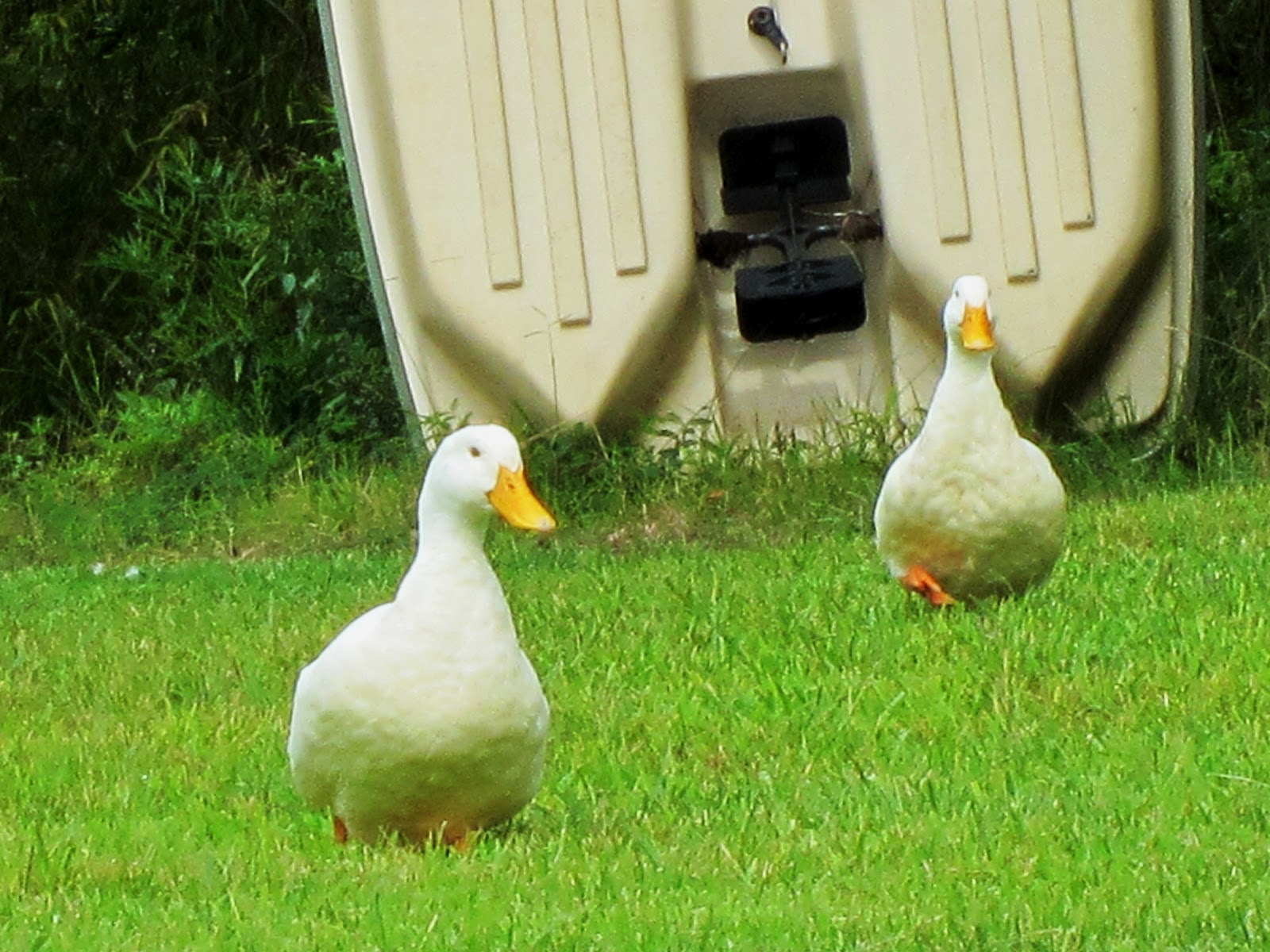
And these are my neighbors (the ones who don’t hunt squirrels):

So maybe this place will take some getting used to, but I suspect not very long at all, really.

In fact, I think I’ve got to visit this Sassy Butts place pretty soon, to see exactly what it is you bake at a BBQ (or BBQ at a bakery?).